
|
|
||||||||||||||||||


|
 |
|
|
|
|
|
|
|||
|
|
Dany Laferrière : When painting engages in dialogue with writing 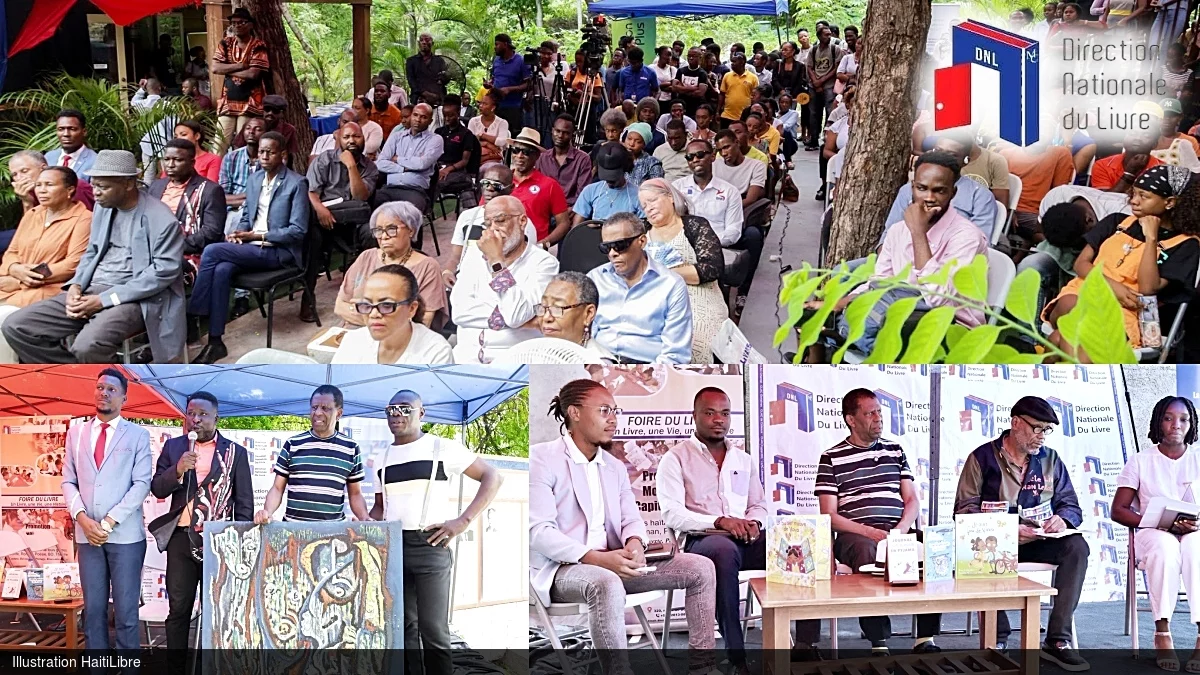
As part of academician Dany Laferrière's tour of Haiti, the National Book Directorate (DNL) had the privilege of hosting a "Carte Blanche" (open forum) event for the writer at its offices. Front an audience of students, teachers, researchers, and cultural figures, Laferrière shared insightful reflections on his artistic journey, his connection to Haiti, and the growing importance of painting in his work. Ernst Saint-Louis, the Director General of the DNL, thanked the State University of Haiti for inviting Dany Laferrière and for honoring him in this way. In a panel discussion moderated by Professor Marc Exavier and students Kenson Anius, Euthnide Elasco, and Shakespeare Émile from the Master's program in Literature, Philosophy, and Transcultural Studies at the École Normale Supérieure (ENS), Dany Laferrière freely addressed several themes related to his work and his vision of art and writing. When asked about the evolution of his work since 2018, he explained that the 2010 earthquake had triggered a true creative metamorphosis within him : "I was exhausted. Words had abandoned me, and forms became more restful." It was in this context that he began to draw and then to paint, discovering in color a new way of inhabiting the world. He clarified, however, that painting is not a substitute for his writing, but rather the opening of another space for creation. "It’s not because I could no longer write." "It was a weariness with words themselves," he confided, thus highlighting the complementarity between these two artistic languages. Writing and image, so to speak, respond to the same quest : that of simplicity, intensity, and another way of expressing our relationship to the world. Speaking of Haitian painters who influenced his development—Wilson Bigaud, Jasmin Joseph, Jean-René Jérôme, and the artists from the Centre d’Art—Laferrière recognizes a profoundly popular force in Haitian art. "Haiti’s uniqueness lies in the accessible and popular nature of its painting," he observed. Moreover, "in Haiti, painting occupies a place as important as football in the collective imagination." He is convinced that art should not be reserved for an elite, because it represents an act of authority over the lives of all those who dedicate themselves to it. Regarding his book "L’Obsession du rouge" (The Obsession with Red) the academician explained that red symbolizes blood, celebration, creation, and death. Through the contrast between a murdered young artist and a gang leader obsessed with fame, he formulates a fundamental reflection : "Art must not only protect or console; it must also disturb." "The Obsession with Red" thus allows him to address Haitian violence in a way that goes beyond mere news stories, situating it within a broader reflection on creation, power, and human dignity. Another highlight of this meeting was the discussion surrounding the Haitian night, the central theme of his book "Dans la splendeur de la nuit" (In the Splendor of the Night) Dany Laferrière sees it as a space of intimacy, creation, confidences, and freedom. "The night creates art," he said. He laments the fact that insecurity today deprives so many people, women in particular, of this essential experience. He finally praised Haiti's cultural dynamism despite the crises plaguing the country. Judging by the commitment of young artists, the proliferation of exhibitions, and the emergence of new generations of creators, artistic creation has never been so vibrant. More than just a literary conversation, this "Carte Blanche" offered by the National Book Directorate proved to be a moment of profound reflection on memory, identity, artistic creation, and the capacity of Haitian art to resist the anguish of the present and to forge new horizons of universality. IH/ iciHaiti
|








|
|
Why IciHaiti ? |
Contact us |
Français
Copyright © 2010 - 2026 IciHaiti.com |