
|
|
||||||||||||||||||


|
 |
|
|
|
|
|
|
|||
|
|
Donation of rabbits and livestock equipment to 100 families in Haiti 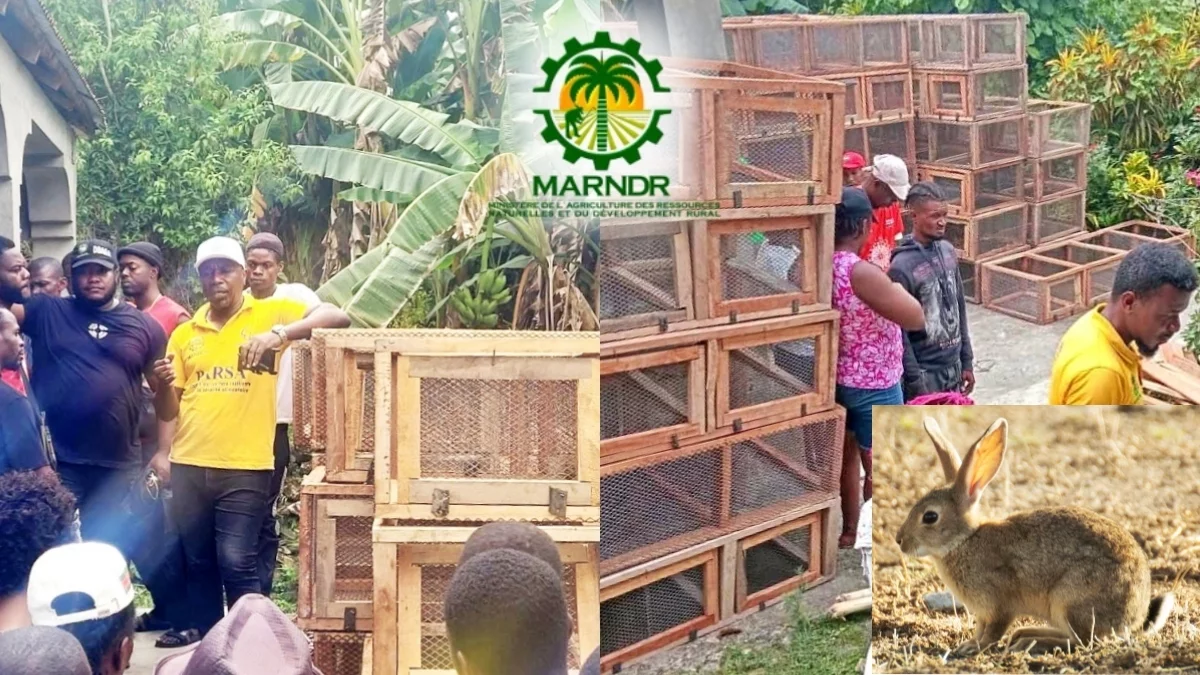
As part of a pilot phase of the Resilient Agriculture for Food Security Project (PARSA), the Haiti's Ministry of Agriculture, Natural Resources and Rural Development (MARNDR) distributed improved strain rabbits of the species Oryctolagus cuniculus to 100 families in the first section of Anote, in Moron (Grand'Anse Department, Jérémie district). This distribution took place in the presence of local authorities and Agronomist Ralph Wendy Despeines, the Grand'Anse Departmental Director of Agriculture. At the end of the distribution day, each household received a starter kit consisting of four breeding rabbits and essential breeding equipment to facilitate the start of this activity under optimal conditions and ensure its sustainability. Prior to this distribution, the beneficiaries received technical training on best practices in rabbit farming, designed to provide them with essential knowledge regarding feeding, reproduction, health care, and herd management. This distribution of rabbits and farming equipment was carried out as part of a pilot phase of the Resilient Agriculture for Food Security Project (PARSA) for 100 families in the first communal section of Anote, Moron, with the aim of strengthening food security, improving the incomes of rural households, and promoting short-cycle livestock farming in the Grand'Anse department. Agronomist Ralph Wendy Despeines commended PARSA's commitment to vulnerable farming communities. In his remarks, he noted that this activity aligns with the Ministry of Agriculture's efforts to increase the resilience of rural families in the face of economic and climate challenges. Despeines highlighted the many advantages of rabbit farming, emphasizing that this sector offers numerous benefits for family farms. Easy to raise, rabbits require little space, reproduce quickly, and can be fed largely with locally available fodder and resources. Their high reproductive cycle allows families to gradually increase their herds, have a regular source of animal protein, and generate income through the sale of breeding stock or meat. From a nutritional standpoint, rabbit meat is recognized for its high nutritional value. Rich in high-quality protein, low in fat and cholesterol, it is an excellent source of essential vitamins and minerals, particularly iron, phosphorus, and B vitamins. Its consumption contributes to improving the nutritional status of households, especially children, pregnant women, and the elderly. By fostering the development of a new livestock sector, the PARSA project encourages the creation of income-generating activities, stimulates local economic exchange, and strengthens families' resilience in the face of food insecurity. In the medium term, the increase in rabbit farming could contribute to improving the local supply of animal protein, reducing dependence on imported products, and creating new opportunities for young people and women in rural areas. This pilot phase will serve as a test to evaluate the results and consider expanding the project to other municipalities in the department. IH/ iciHaiti
|








|
|
Why IciHaiti ? |
Contact us |
Français
Copyright © 2010 - 2026 IciHaiti.com |