
|
|
||||||||||||||||||


|
 |
|
|
|
|
|
|
|||
|
|
Agriculture : Progress on riverbank protection work at Ravine Sèche 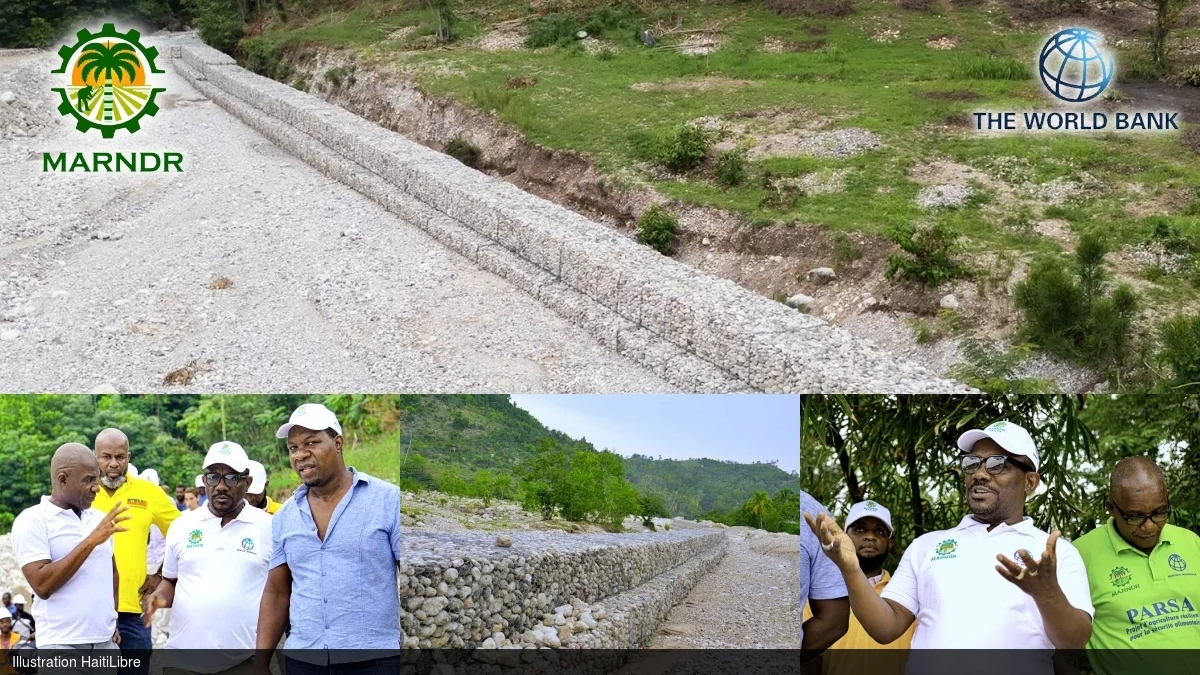
On Tuesday, November 3rd, 2026, as part of a World Bank support mission for the Resilient Agriculture for Food Security Project (PARSA) and the Resilient Productive Territories Project (TPR II) in the Grand Sud region, a delegation—comprising representatives from the World Bank, the Ministry of Agriculture, and the PARSA coordination team conducted a field visit to Ferme Leblanc, in the commune of Torbeck. The visit provided an opportunity to assess the progress of bank stabilization work along the Ravine Sèche watercourse and to evaluate its impact on local agricultural holdings and riverside communities. Of the 750 linear meters of protection planned, 730.6 meters have already been completed, representing an execution rate of approximately 97.4%. Regarding the installation of gabions, 6,974.4 m³ have been completed out of a total planned volume of 8,935.1 m³, amounting to nearly 78% completion. These structures are designed to reduce erosion, stabilize riverbanks, and curb the degradation of land along the watercourse. They also help protect nearby agricultural areas from the effects of surface runoff and heavy rainfall. Speaking during the visit, Haiti's Minister of Agriculture, agronomist Marcelin Aubourg, highlighted the strategic importance of the Ferme Leblanc area, describing it as a key hub for agricultural production in the country. He commended the farmers for their efforts to sustain their production activities despite the environmental challenges they face. The Minister also encouraged community members to establish a committee tasked with contributing to the management and preservation of these protective structures. This community-based structure will be tasked, among other things, with preventing sand extraction activities that could weaken the infrastructure, while also ensuring the long-term sustainability of these assets. Emphasis was placed on the collective responsibility to safeguard the investments made for the benefit of the local population. Valens Mwumvaneza, a member of the World Bank delegation and project manager, expressed his satisfaction with the quality of the work completed and the level of involvement from the local population. He specifically commended the participation of women, who contributed technical input to the construction process. He also highlighted the fact that the human resources and skills required for the project were available within the community itself—a level of local engagement that underscores the value of a community-based approach to implementing rural infrastructure and fostering a sense of local ownership over such investments. For his part, agronomist Gérald Neuvième, coordinator of the PARSA project, noted that these infrastructure works were made possible through World Bank funding. He underscored the significance of these investments in efforts to protect agricultural land, support the livelihoods of producers, and strengthen the resilience of rural communities. The beneficiaries also expressed their satisfaction with the completed works. They recalled that, in the past, heavy rains and flash floods from the ravine were a constant source of concern for the residents of Ferme Leblanc. Such flooding and runoff frequently threatened their agricultural plots, crops, and livestock, thereby jeopardizing their livelihoods. With the installation of gabion structures, local residents now benefit from improved protection against risks associated with adverse weather conditions. Beyond the bank stabilization work at Ravine Sèche, the PARSA project, implemented by the MARNDR, continues its interventions in the realm of rural infrastructure. These efforts are primarily aimed at improving access to production areas, facilitating the transport of agricultural goods, and strengthening the links between producers and markets. IH/ iciHaiti
|








|
|
Why IciHaiti ? |
Contact us |
Français
Copyright © 2010 - 2026 IciHaiti.com |